
Saturday (26/06/2021), PP Kagama and UGM, and UGM Press held a webinar through the Zoom Meetings application-themed Kagama Literacy. In this 5th series, we dissect the book entitled “Ekonomi Kelembagaan & Desentralisasi” by Prof. Wihana Kirana Jaya, M.Soc., Sc, Ph.D. Two figures, namely Ir. Budi Karya Sumadi (Menhub RI & Deputy I PP Kagama), Prof. Ir. Panut Mulyono, M.Eng., D.Eng., IPU, ASEAN Eng. (UGM Chancellor) was present at the beginning of the event to give a speech. Delighted to be the keynote speaker is H. Ganjar Pranowo, S.H. (Chairman of PP Kagama), M.IP, and Dr. AAGN Ari Dwipayana (Secretary-General of PP Kagama). The webinar presents four resource persons who are competent in their fields: Made Suwandi, M.Soc.Sc., Ph.D., Prof. Robert A. Simanjuntak, M.Sc., Ph.D., Drs. Astera Primanto Bhakti, M.Tax. and Dr. Sukarwo, M.S. The webinar course is guided by Dr. Friderica Widyasari Dewi, M.B.A, and Muthiah from PP Kagama’s PR team.
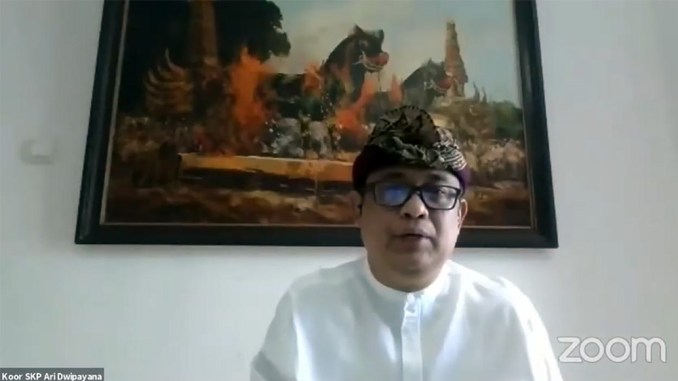
“Ekonomi Kelembagaan & Desentralisasi have a positive correlation in growing the regional economy,” said Ari Dwipayana starting his speech.
Ari Dwipayana, who also serves as the Coordinator of the Special Staff of the President of the Republic of Indonesia, emphasized that using an institutional economic perspective is necessary for viewing development problems. Its relevance is in accordance with the four pillars of transformation proclaimed by the President of the Republic of Indonesia, Ir. Joko Widodo, namely the acceleration of infrastructure development, human capital transformation, institutional transformation, and industrial transformation.
“Emphasis on leadership factors and innovation of regional leaders is needed to educate the public and achieve regional economic development goals,” concluded Ari Dwipayana.

Almost the same, Ganjar Pranowo said. “An interesting book and present as a guide in developing the regional economy. The regions must make improvements in overcoming economic development during the Covid-19 pandemic.”
“The outbreak in Kudus, Central Java requires calm and leadership alertness in handling the delta variant. In the context of regional autonomy, the governor becomes the “big brother” of the regent or mayor in a regency or city area. The Central Java Province then took over the Kudus case. The Central Java Provincial Government has prepared an office to back up the handling of Covid-19 in Kudus.” added Ganjar.
“Regional autonomy that has been given and stipulated by the law must be carried out properly by mobilizing all the efforts owned by the region. In the case of Covid-19 in Kudus, for example, the handling is decentralized and involves various parties such as the TNI and Polri. A regional leader’s sense of crisis is tested in this situation.” said Ganjar closing his speech.

The first speaker, Prof. Robert A. Simanjuntak, provided input so that the book “Ekonomi Kelembagaan & Desentralisasi” can be read by various elements in society by adding multiple things that have not been listed, such as the arguments in the book that need to be formulated more clearly and have more specific objectives.
“In the introductory chapter, it is necessary to provide an overview of the discussion structure on the issue of decentralization using NIE (New Institutional Economic) theories. Then, underline the main arguments in each chapter. NIE theories must be explored in more detail as to how they differ from other mainstream economic theories.” concluded the FEB UI professor.
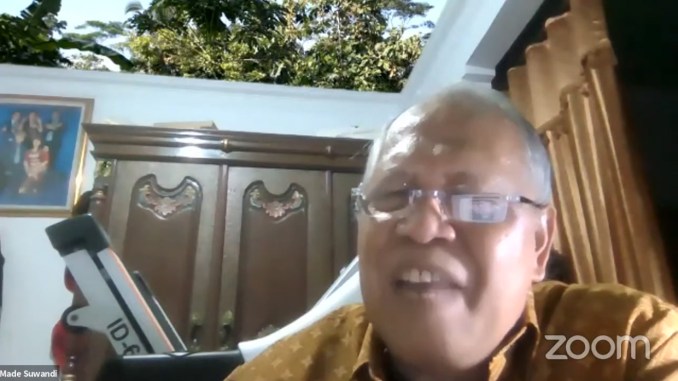
The second discussant, Made Suwandi, tries to relate the book to the direct elections created in 2004. Direct elections at the practical level have even increased the number of KKN such as bribery to gain office and money politics. Much of the financial authority given to regions after the implementation of regional autonomy is very weak, especially in supervision.
“In addition to the aspect of weak supervision, it is exacerbated by aspects of social control, weak checks and balances, and overlapping policies. The BPK, KPK, and other supervisory bodies have had quite a bit of difficulty in monitoring the irregularities that occur in the regions.” said the expert on the Regional Autonomy Advisory Council.
“Decentralization will be successful if it follows a clear rule of law. The central government should encourage local governments to understand the process of regional economic governance. The need for careful preparation in preparing leaders in the region, the need to raise awareness of the importance of education in developing the region.” said Made Suwandi ending his presentation.
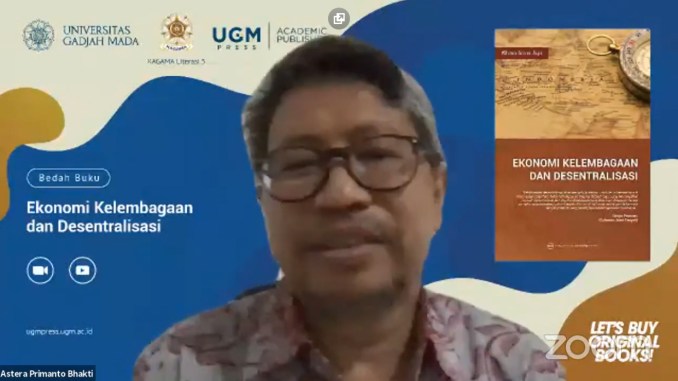
In line with the two previous discussants, Astera Primanto Bhakti appreciates the presence of the institutional economics book as a refreshing effort to revisit fiscal decentralization starting from its history, comparison with other countries. All circles can read this book, both economists and ordinary people in society.
“The institutional economic approach is the most acceptable approach for various groups. The criticism that becomes our common homework is that it is difficult to find areas not included in the PAPs in the BPK audit. Social and economic inequalities in various regions are also increasing. The implementation of decentralization aims to eliminate inequality and widens the gap,” concluded the Director-General of Fiscal Balance at the Ministry of Finance of the Republic of Indonesia.
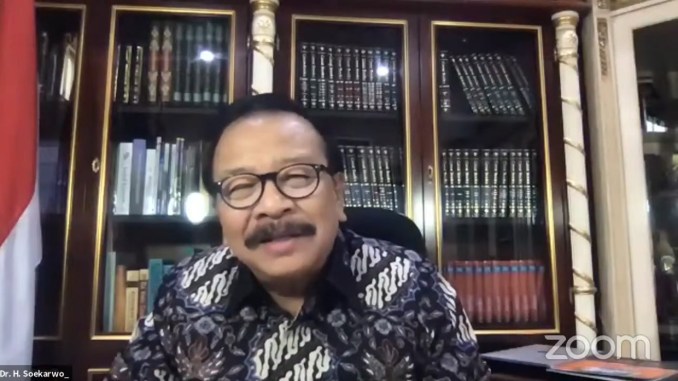
In the last discussion, Sukarwo, M.S., a member of the Advisory Council of the President of the Republic of Indonesia, drew a case study on cooperatives and SMEs with an institutional economic approach. The global financial crisis in 2008 did not destroy the Indonesian economy. One savior of the Indonesian economy is cooperatives and MSMEs.
“My experience as Governor of East Java (2009-2019), together with the Regional Research Council and BPS East Java, found that the condition of MSMEs in East Java was feasible but not bankable. Seeing this case, the East Java Provincial Government and the DPRD made a regional credit guarantee by guaranteeing MSMEs through APBD funds. The decision resulted in the East Java Regional Government BPR becoming an MSME Bank. Provide capital through a loan agreement with a 2% demand deposit and 6% interest guaranteed by Jamkrida.” concluded Sukarwo. [arma/KAGAMA]